.png)

Advertisement
.svg)
Today's Explorers
An interview with
An interview with
Dorian and Nat (rewild.club)
May 15, 2026
6
min read
by
Charles Forman
Where are you from?
We’re from France. We both grew up in the south of the country, in Aveyron, a beautiful department that will always feel like home to us.
When did you start your interest in exploration?
In 2011, we were 23 years old when we set off on a spontaneous road trip across Australia in our own car, an old Ford Falcon. We had just finished our Master’s degrees and decided to spend the remaining 3 months on our student visas on the road before going back to France.
We travelled from Port Douglas, near the Great Barrier Reef in the northeast of Australia, all the way to Perth in the southwest. Along the way, we passed through Brisbane, Sydney, Melbourne, and Adelaide, and also ventured into remote central regions like Coober Pedy and across the vast, empty plains of the Nullarbor.
Our car was completely stock and packed with all our belongings. We had no special equipment, just a tent. We camped on beaches and in national parks, moving from one place to another each day without much of a plan. Australia offered incredibly remote places where we truly felt free.
At the time, there was no Google Maps, no iOverlander, and internet access was limited to slow 3G connections near towns and cities. Looking back, that was the moment we realized we could live simply and freely, without relying on big infrastructures, shopping malls, or modern conveniences, just a basic setup and a sense of adventure.
It was total freedom. We loved it. That journey changed us. We discovered that exploration is a way of becoming richer, not financially, but personally. You gain skills, you consume less, you become more aware, and you feel more connected to nature and to people.
What is a brief understanding of your background story up until you started seeking adventure?
Before actively seeking adventure, we were both living and working in Paris. Nat was a Product Manager at a startup, and Dorian worked in finance as a Portfolio Manager.
Our road trip across Australia had left a deep mark on us. Even after returning to a more conventional lifestyle, we kept that spirit alive during our summer holidays, first traveling by motorbike with a tent, and later upgrading to a Land Rover fitted with a rooftop tent.
Along the way, we discovered the overlanding community and started to follow the adventures of other travelers on YouTube. Gradually, the desire for our own big adventure grew stronger.
At the same time, after several years working behind screens, we realized how quickly time was passing. Having been established in our careers for many years, we were fortunate enough to request a sabbatical year, and we decided to take that opportunity to make this dream come true.
What special skills do you have to help with your explorations?
We both have a natural spirit of adventure. Our experience in Australia taught us that discomfort is quickly outweighed by the beauty of discovering new places and living unique moments. It might not sound like a skill, but on the road, it truly is.
On a more practical level, Dorian has always been interested in mechanics. He’s not an expert, but he’s deeply curious and eager to learn. In just a few months before our departure, he built our entire vehicle setup himself, from the hot water system to the electrical installation and woodwork. He reads maps the way others read books and he can drive for hours without getting tired.
Nat is the creative force of the duo. Photography, writing, and sketching are her things. This is a real asset, as it allows us to preserve meaningful memories of life on the road and create unique content, especially her drawings. She has an endless imagination, which also extends to other areas, including cooking. She can prepare delicious meals with whatever ingredients are available, which is often a challenge in remote regions. And finally, she tends to attract every mosquito in the area, which, unintentionally, makes her a very effective mosquito repellent for Dorian.
In the end, however, what matters most is not the skills themselves, but the determination to pursue your adventure. Skills can be learned and improved along the way, but the courage to take the leap is what truly makes the whole thing possible.
Where have you explored so far?
So far, we have traveled to many places in France, our home country, as well as across Europe, including Italy, Spain, Portugal, and Switzerland with our Defender. We also spent some time in Greece, mainly backpacking, as we did in Thailand, Cuba, and Indonesia.
As we mentioned before, we lived in Australia for two years, one year in Finland, and also spent a few months in the United States.
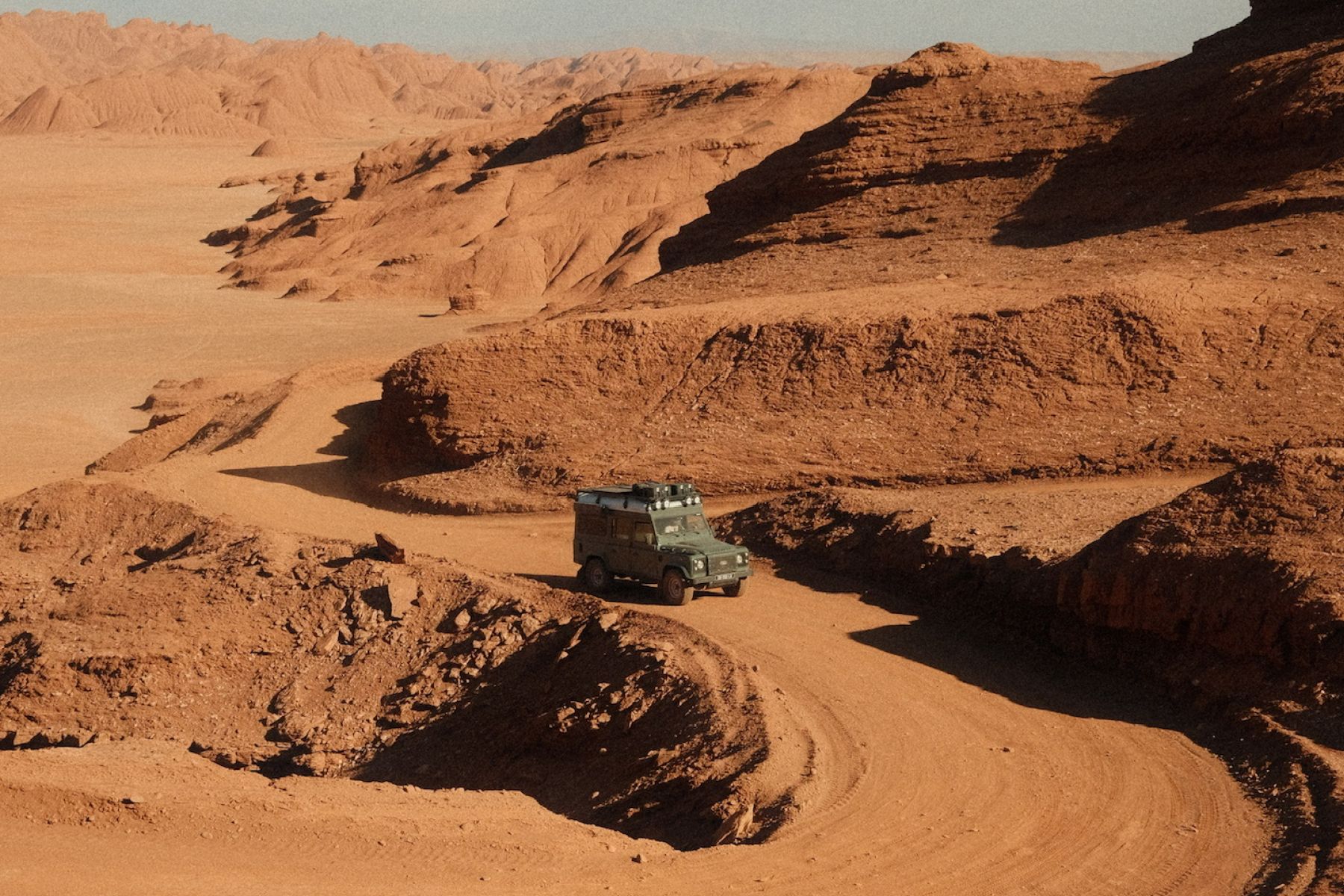
Finally, we traveled through the entire southern part of the Pan-American Highway, which allowed us to explore Uruguay, Argentina, Chile, Bolivia, Peru, Ecuador, and Colombia.
What is a brief understanding of your adventures so far?
We’ve tested many different types of adventure over the years.
As mentioned before, our first real one was in Australia, a simple stock Ford Falcon, a tent, no GPS, no real plans. Just a map, a sense of direction, and the desire to see what would happen. It was raw, spontaneous, and it shaped the way we see travel.
Later, we spent a few weeks backpacking across Asia, Greece, and Cuba. A completely different rhythm. You rely on buses and ferries, you book a room for right now, and you move slowly. You meet people easily and live very locally. We loved that simplicity. But it also comes with limits, especially when you want to reach remote places and realize you have to rely on organized tours to get there.
We also tried motorbike travel with a tent. We absolutely loved it. You’re 100% connected to nature, you smell the air, you feel the temperature changes, the wind, the rain. People approach you everywhere because they’re curious. But for us, it was also the most physically demanding way to travel.
Eventually, we adopted the Land Rover lifestyle. Like the motorcycle, our Defender acts as a magnet, people are naturally curious and incredibly friendly when you arrive somewhere. But the comfort level is very different. You’re protected from the weather, you have privacy to change clothes, you can cook, shower, and live autonomously wherever you stop.
It combines freedom and capability with endurance. You can still go almost anywhere, but you arrive rested and you have a good bed for the night.
What are the top three destinations you hope to explore next, and why?
We are lucky enough to be on a 365 day Panamerican expedition which will offer us the chance to explore the whole central and North America over the following month. This is already a dream. Beside that, our top three would be :
Namibia : we would love to see the dunes, the salt pans, and discover the African wildlife
Kyrgyzstan : we have seen these landscapes through the eyes of many overlanders. It looks really wild with dramatic snow-capped mountains, vast green valleys, crystal-clear alpine lakes, and wild steppes.
Island : we want to see the raw volcanic landscapes, towering glaciers, black sand beaches, and these beautiful waterfalls
Where would you recommend others visit?
This is really a personal question. For people like us, who love to explore, we would recommend Argentina for two regions: Patagonia for its wilderness, endless steppes, and deep blue lakes; and the Puna, which is mainly made up of extremely remote high plateaus, unique landscapes, salt flats, hot springs, and lagoons filled with flamingos.
We believe Australia is also a dream country for overlanders, with vast unexplored lands, unique wildlife, friendly people, and pristine wild beaches.France also offers a huge diversity of cultures and landscapes, while being a relatively small country and very easy to travel.
Similarly, we really enjoyed the north of Italy, which has a perfect mix of impressive mountains, lakes, and forests, while the villages and countryside remain incredibly rich and full of life.
And finally, for culture and ancient traditions, we loved Peru. The number of Inca and pre-Inca ruins is incredible, the indigenous communities are very diverse, and the Andes are lush and impressive.
How do you primarily travel on your adventures today?
We travel with our Land Rover Defender, a classic model from 2008. It's a rough but perfect vehicle for such an expedition, one that can truly go anywhere, your own skills being the only limits. It currently has 190,000km on the clock and works like a charm, especially considering what we put it through: extreme cold and heat, high elevation, river crossings, thousands of kilometers of corrugation, with no real rest and only basic maintenance. We love it, and we also strongly believe it helps us connect with locals, who everywhere we've been are genuinely curious about this vehicle.
Our first top modification is the pop-up roof, a real game changer. It offers far more comfort than any rooftop tent on the market, with much better resistance to wind, rain and snow. It adds significant living space and security to our setup, and camp life becomes so much easier.
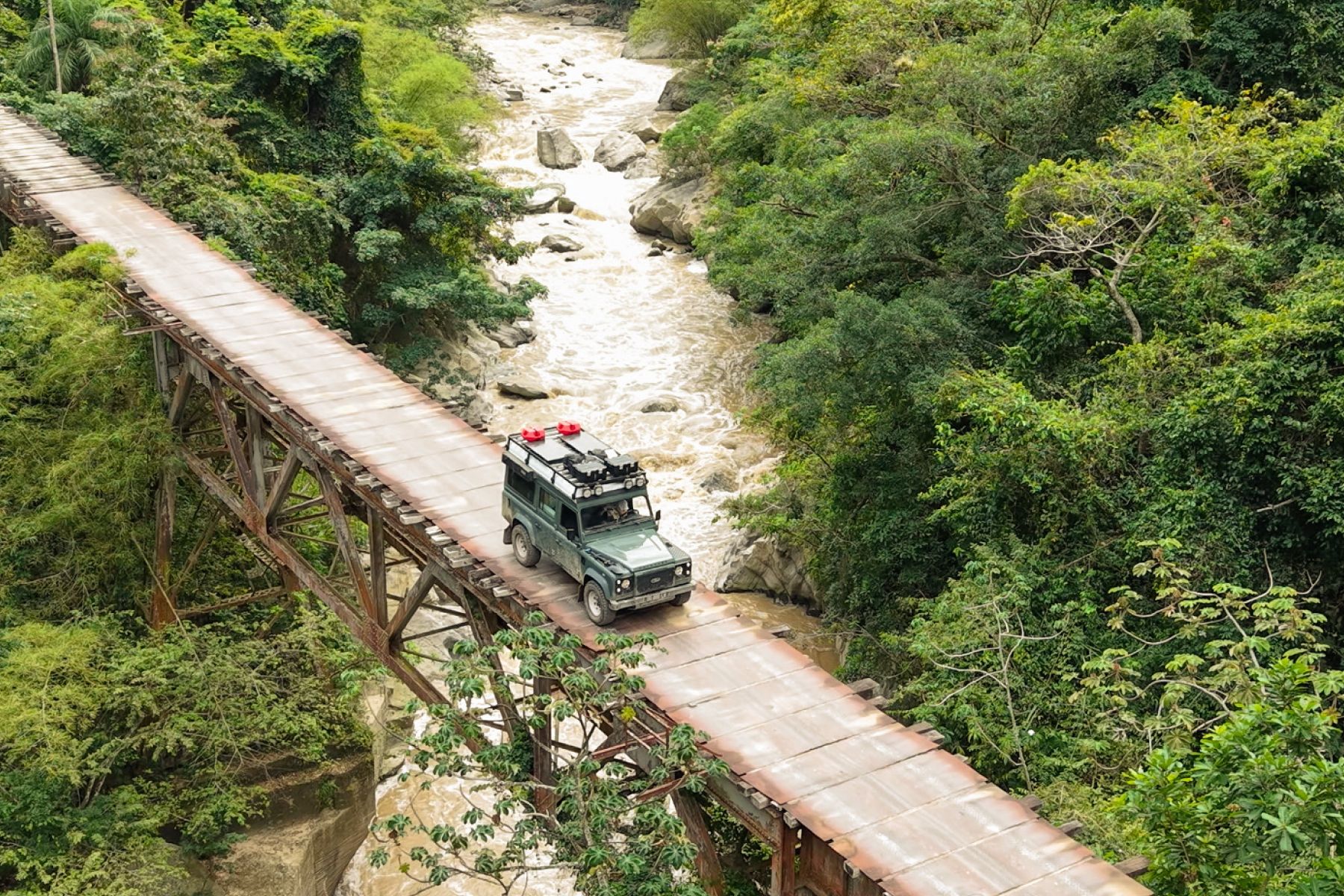
The second is our water filtration system, which gives us real freedom and peace of mind. We carry a total of 100L of water capacity, 100% drinkable at any time. In remote areas, we can pump directly from rivers or lakes, saving time, unlocking itineraries with no infrastructure, and we have never once paid for water on this expedition.
Finally, our electrical setup has been a quiet revolution. A 280Ah battery fed by 200W solar panels and a DC-DC charger gives us all the power we need, including running a full induction stove even during long remote cooking sessions. No gas, no searching for the right adapter or bottle standard in places where supplies are scarce. Just like the water system, it simplifies life enormously and keeps us moving.
What are five pieces of equipment that you always travel with?
For this one, we could have mentioned our camping chair, table, shovel… but we believe that, to be fair, what we would always travel with, no matter the travel style, duration, or destination, is much more simple and personal.
To us, traveling means creating memories, connecting with other cultures, developing our skills, and discovering new landscapes. That’s why we always travel with Nat’s sketchbook and drawing pens. Nat is an artist; she truly needs to create from what she sees and experiences. Dorian, on the other hand, is more focused on planning the next steps. Drawing brings such a special feeling; it allows you to slow down and really process what you see. We’ll have tons of photos, but only one sketchbook, and once the trip is over, we’ll probably look at it more than the photos, as it’s a physical object. The act of deciding what to draw is, in itself, a way of reliving special moments, the ones that created a strong emotion inside you that you don’t want to forget.
But we don’t only draw our adventures; we also love taking photos. Not the typical Instagram shots, but real-life moments: people in the streets in traditional clothes, a local food stand, animals sneaking around our car, painted trucks, or a tuk-tuk in the street… the kind of details you only notice here and there. They may not be famous landmarks, but they quietly say where you are without needing to show it. To us, these are also the photos we love to look back on 10 years later, because they bring back deep memories and make you smile as you relive those precise moments. For now, our photography equipment is composed of a Fujifilm X100v and a brand new DJI Air 3S (we lost our reliable Mini 3 Pro in the Colombian jungle).
Our next “piece of equipment” is also unconventional, but closely linked to the idea of creating memories. Some memories are even better when shared with family and friends, who can follow the journey remotely, sitting on their couch, yet still feeling part of the adventure. Instagram is one way to do it, but we particularly enjoy sharing longer stories and deeper reflections on Polarsteps. This app allows us to keep our family updated on our live location, connect photos with places and time, and offers virtually unlimited space to describe our experiences in detail.
Finally, no matter the type of travel, whether it is backpacking, riding a motorbike, or driving our beloved Land Rover Defender, and whether in Europe, Asia, or the Americas, we always rely on several navigation systems and apps with offline maps. There’s always that moment when you arrive in a new country late at night, with no data roaming, no Starlink, and no clear idea of where to go. Locals can help, of course, but it can be time-consuming and sometimes unreliable.
Over time, we’ve gained a lot of experience with navigation tools. We now use a selection of apps depending on the situation, because trekking is not the same as overlanding, which is different from simply getting from A to B. Today, during our expedition, we mainly use four apps: Google Maps for daily navigation; Gaia GPS for planning, exploring, recording tracks, and loading GPX files; MapOut for highly specific or remote routes and unconventional planning; and AllTrails for trekking.
To add “one more thing,” we would say a water filtering bottle, so we can always have access to safe drinking water anywhere in the world. It’s a lightweight and efficient piece of equipment, so no excuses.
What inspires you to explore more?
Exploration keeps pulling us further and helps us to grow.
The further we go, the more we realize how much we haven't seen. Each remote place we reach quietly raises the bar for the next one. Not in a competitive way, but in the sense that your eyes get calibrated differently. You start enjoying the simple things that don't show up on lists. It's no longer just about seeing new places, but about seeking moments.
While we still visit some, we've stopped looking for overcrowded, ultra-Instagrammable places. We prefer an unknown wild waterfall or a crater lake where our path might eventually cross a couple of scarlet macaws to an ultra-fancy infinity pool at a trendy hotel. Don't get us wrong, we still enjoy these luxurious experiences, but we now enjoy the wild and unknown even more.
On the road, in the dust, through long days of driving and unexpected encounters, we slowly begin to notice how much we are changing. Travel pushes us to adapt, to question, and to grow. Step by step, it shapes who we are becoming, hopefully more capable, more confident, more courageous, and kinder.
How do you engage with others?
During our current expedition, we primarily use Instagram to connect with fellow travelers and our community. It’s an incredible platform to meet like-minded people who share a passion for travel and exploration, not to mention the Land Rover community, which is truly inspiring.
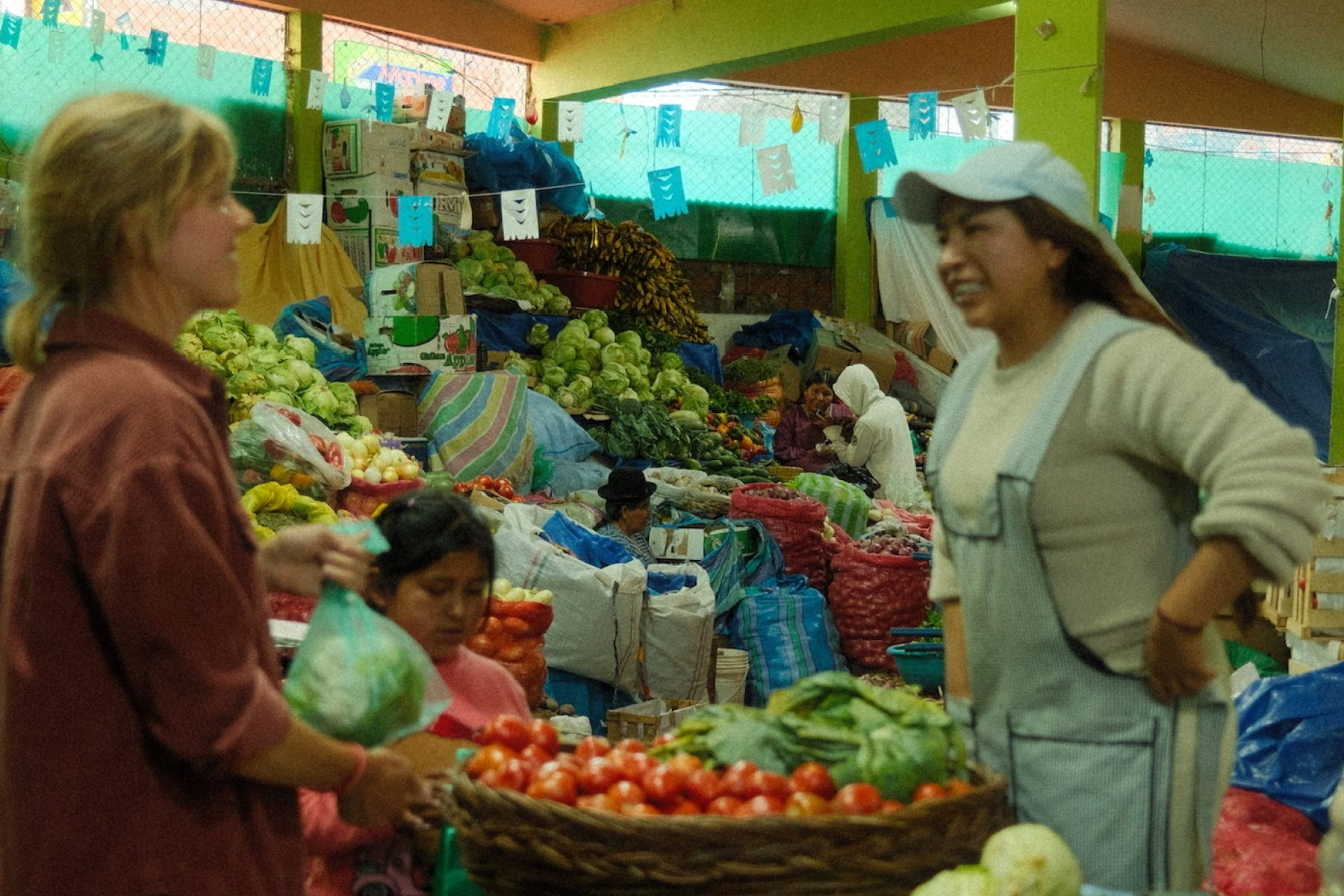
That said, what we value most are real-life encounters. We make a genuine effort to speak Spanish and engage with locals whenever we can. People are incredibly welcoming, and these exchanges often become some of the most memorable moments of our journey.
From time to time, we also cross paths with other travelers on the road. These spontaneous meetings often turn into shared bivouacs and simple yet meaningful moments around an “apéro”.
Why is it important to embrace global cultures?
We’ve been fortunate to experience what it truly means to live within different cultures from a young age. Since then, travel has never been just about going somewhere, taking photos, or staying in a five-star hotel by the pool.
For us, traveling and exploring means immersing ourselves in the cultures we encounter, spending time in the places we visit, connecting with locals, and following their recommendations for places that genuinely matter to them. More often than not, these off-the-beaten-path experiences offer far greater depth and meaning than standard, tour-operated stops designed for quick photo opportunities.
Beyond the places themselves, it’s the human connections that make the difference. Conversations with locals open the door to stories, perspectives, and shared knowledge that you simply can’t find in any guidebook.
What are your goals when you explore?
We stopped making rigid plans a long time ago.
We have a rough shape for this expedition, a list of places we didn't want to miss, and a few experiences we had been thinking about for years. But the goal was never to tick boxes. It was to stay open long enough for something unexpected to happen, and then follow it.
In practice, that means slowing down or changing plans when a place earns it. Staying an extra day because a local suggested a track that isn't on any map or skipping a famous landmark because the road to get somewhere else felt more interesting. The quality of the experience always matters more than the quantity of places covered.
If there's one thing that drives us, it's the search for simple moments. Not curated, not staged, not designed for a photo. A conversation that goes longer than expected. A landscape that makes you stop talking. A meal shared with strangers that you still think about weeks later. Those are the moments we're actually chasing.
What are some challenges you have experienced?
Altitude, without a doubt.
Crossing the Andes is something we, as Europeans, tend to underestimate. What's striking is how quickly and almost imperceptibly you can reach extreme altitudes. The roads are often in good condition, there's not always snow, temperatures can feel manageable, and there are few of the elevation markers we are used to back in Europe. And then it hits you. Breathing becomes difficult, even at rest, and any physical effort suddenly feels exhausting. The Defender felt it too. Thinner air means less oxygen in the combustion cycle, which means less power and more heat. We lost count of how many times we had to stop and let the engine cool down on those long climbs, sitting in silence, surrounded by nothing but mountains.
The other challenge that stays with us happened in Bolivia. Fuel was already difficult to find, with long queues and strict rationing at every station. Then overnight, without warning, the government announced the end of subsidised diesel prices. The price jumped from twenty cents to one dollar per litre in a matter of hours. The country fell into immediate chaos. Roadblocks appeared across the main routes within hours, set up by locals, taxi drivers, bus operators and truckers protesting the decision. We had to leave quickly, rerouting through narrow mountain tracks to avoid the blockades and find a way out of the country before the borders were blocked too. That day was truly intense, on our nerves and on the Defender, which had to tackle something close to a Dakar rally stage. It was a sharp reminder that on a long expedition, not all obstacles are physical. Some arrive overnight, in the form of a political decision, and require you to adapt just as fast.
What has been your most meaningful moment so far?
The meeting with Rosa and Matilda, shepherds in the Argentinian Puna, remains one of our most meaningful moments so far.
Before leaving Europe for our expedition, our friends Nick and Mathilde from Next Meridian told us about a remote and magical place hidden in the mountains. A natural hot spring, accessible only after a long off-road track involving multiple river crossings and more than 2000 meters of elevation gain.
In reality, it was day one of a five-day crossing between Antofagasta de la Sierra and San Antonio de los Cobres.
That morning, we left the small town of Antofagasta de la Sierra after preparing for what we believed would be five days without human contact. Water, fuel, and supplies were all carefully loaded, and soon we were deep into the mountains.
After a few hours, the track slowly disappeared into a sequence of river crossings and a narrow valley. Then it climbed steadily upwards, deeper into the Andes. Without really noticing, we were already above 3000 meters. The terrain became steeper, the sun stronger, and the combination of altitude, weight, and rough conditions began to challenge both us and the vehicle. Our Defender started to overheat, forcing us to stop regularly and wait for the engine to cool down. In hindsight, these pauses became some of the most powerful moments of the day, giving us time to absorb the overwhelming landscape around us. We felt completely immersed, as if we were driving above the world itself, surrounded by endless mountains.
As sunset approached, we finally reached the point marked on the map. The last section was almost unreal, a steep descent after a full day of climbing, requiring low gear and diff lock to carefully bring the vehicle down.
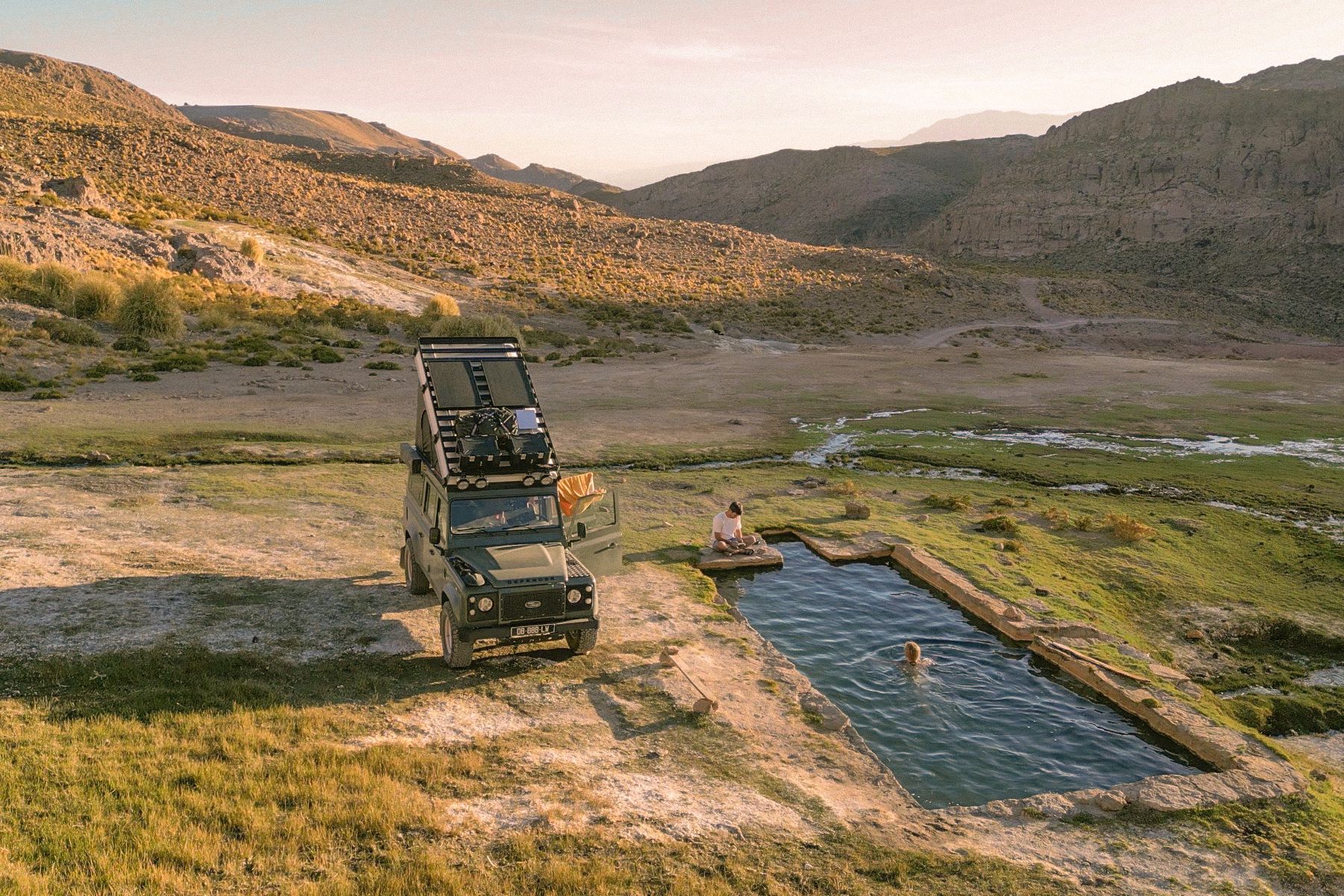
And then came the reveal. A perfect hot spring, completely isolated in the middle of the Andes.
We parked, jumped into the 38°C water, and watched the sun set in absolute silence. It felt like a reward at the end of an already perfect day.
But the experience did not end there.
Not far from the spring, we discovered a small stone house. Inside, we met two sisters, Rosa and Matilda, shepherds living in this extremely remote place. We spent hours with them, speaking a mix of Spanish and gestures, listening to their stories and their way of life in the mountains.
We shared our Starlink connection, which allowed them to call their family and friends. In return, we were offered fresh homemade ricotta.
Leaving the next day was genuinely difficult.
Thank you Rosa and Matilda for your kindness.
How has exploration changed you?
Exploration has changed us in ways we didn't expect and couldn't have planned for.
The most visible change is probably in how we handle uncertainty. Before this expedition, an unexpected problem, a mechanical issue, a wrong turn, a plan falling apart, would have triggered stress. Now it triggers curiosity. We've been in enough situations where things went sideways and somehow turned into the best part of the day that we've stopped fighting the unpredictable and started leaning into it.
It has also made us much more present. Life on the road strips away the noise. You wake up, you look at what's around you, and that's enough. There's no inbox, no commute, no background anxiety about what comes next. Just the track ahead, the weather, and whatever the day decides to offer.
And perhaps most deeply, it has changed the way we see people. We were not prepared for the generosity we would encounter. When they see the Land Rover, which is obviously not a local vehicle here in the Americas, people wave from the roadside with huge smiles, strangers stop us in the street just to ask where we've come from and wish us well, and sometimes, within minutes of meeting someone, we find ourselves invited to sleep at their home simply because they are kind and genuinely moved by the adventure. These moments catch you off guard every time. They remind you that warmth and openness exist everywhere, often in the places you least expect it, and they have made us more generous, more patient, and more willing to trust the world around us.
What is the number one lesson that you have learnt through your exploration?
Trust what you yourself, and what you experience over what you're told.
Before leaving, we heard a lot of opinions. Don't take a Land Rover, it'll break down constantly. Don't go to that region, it's not safe. Wait for a better time. People meant well, and we listened carefully. But you also need to trust yourself, and once on the road, we quickly realized that most of these warnings were built on fear rather than experience, second-hand stories passed along until they became facts.
The reality we found was almost always different. More welcoming, more manageable, more beautiful than described.
That doesn't mean ignoring advice. It means filtering it. There's a difference between someone who has driven that road and someone who has read about it. We've learned to tell them apart, and to give more weight to our own eyes, our own judgment, and our own instincts than to anything we heard before we left.
How do you explore locally?
When we are in France, we love spending time in nature. Hopefully, our farm house is surrounded with green valleys, natural rivers, and lakes. Every weekend we go trekking around and experiment with one of the thousands of small trails sneaking into our region. We always discover beautiful hidden spots or points of view that we love, ruins of old castles or churches. For that, we draw our own tracks on MapOut and we go and try to follow the path.
And of course, we also love to take time to explore with our Defender. Once again, the Aveyron, where we are from, is an amazing playground. It offers low mountains, amazing crystal blue rivers in canyons, lakes, etc.
What does the explmore mantra mean to you?
Exploring more of the world is the starting point, the decision to go further, to take the road less travelled, to resist the comfort of the familiar. But exploration on its own is just movement. What gives it meaning is the second part: engaging with others. The encounters, the conversations, the strangers who become hosts, the locals who point you toward a place that isn't on any map. That human layer is what transforms a journey into an experience.
And embracing global cultures is what stays with you long after you've come home. It's the understanding that there are a thousand different ways to live a life, and that none of them is wrong. The more cultures you genuinely immerse yourself in, the harder it becomes to see the world in simple terms. That shift in perspective is, to us, the most lasting gift that travel offers.
What advice would you give to others who are seeking life changing adventure?
Just go. Don't wait for the perfect moment. You will love it so much, and it will gift you with a better version of yourself.
All images subject to copyright.
Today's explorers
Want to share your story?
We would love to hear how your life has changed, because of adventure.
More stories
Advertisement
©2025 explmore ltd. UK Company Reg. 12586342